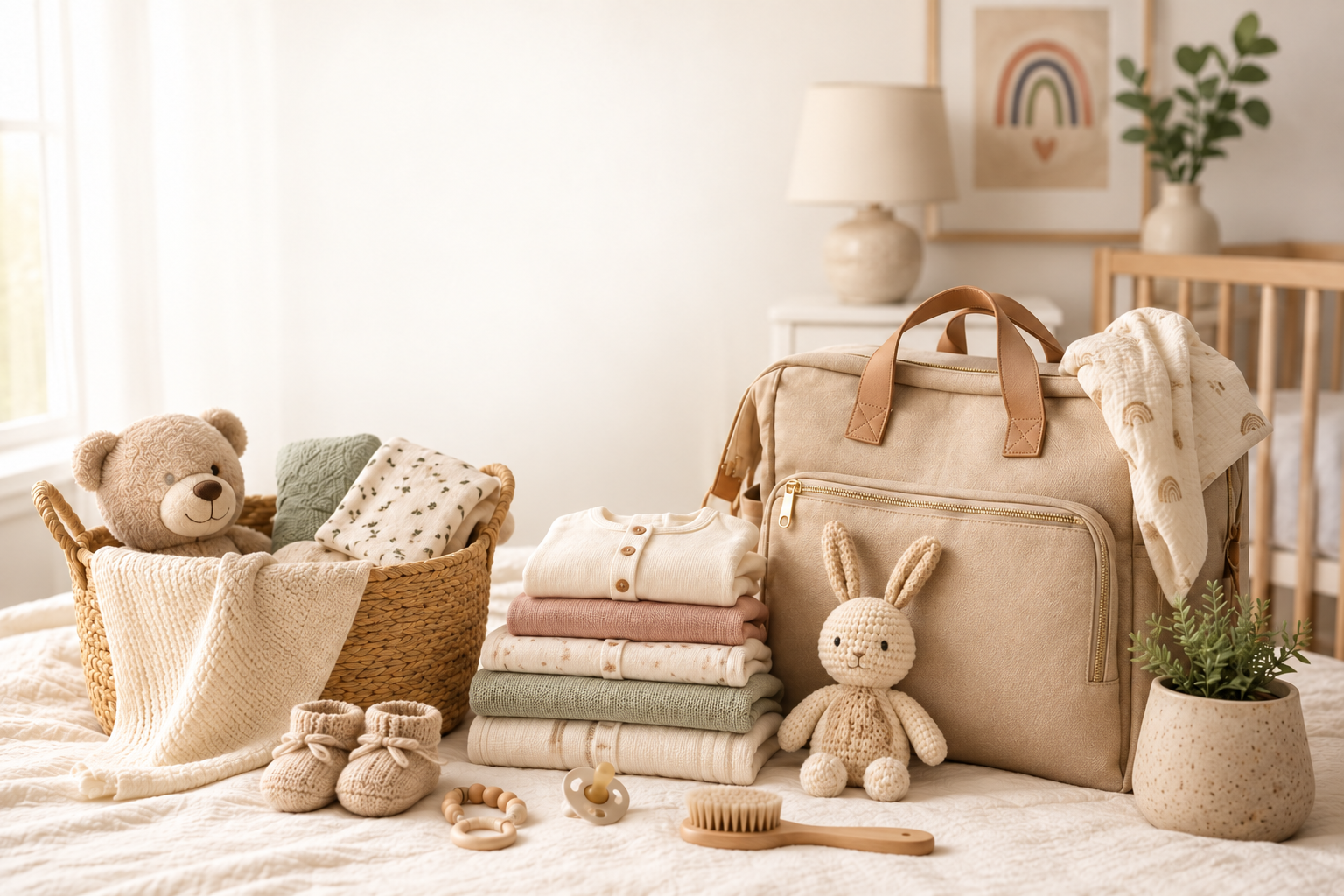
When I was pregnant with my first baby, I walked into a baby store the way I walk into a beautiful homeware shop: wanting absolutely everything.
But what are the real essentials? What does a baby actually need? And which products genuinely make life easier for a brand-new mom?
I was overwhelmed, hormonal and completely lost.
So, this is the baby registry list I wish someone had handed me—the sanity-saving, clutter-reducing, genuinely useful guide to baby and mom essentials that are actually worth the money.
1. The Travel System
Car seat. Stroller. These are non-negotiable.
School runs. Coffee runs. Those “I need to leave the house before I lose my mind” runs.
A lightweight travel system, such as the Graco Modes Travel System, is one of those purchases that can feel expensive at first—until you realise you’re using it almost every single day.
Tip:
What to look for:
👉 Car seat compatibility
Choose a travel system that allows you to lift the infant car seat straight out of the car and click it onto the stroller. This is especially useful when your baby has finally fallen asleep and you don’t want to risk waking them.
👉 A one-hand fold
Look for something compact, lightweight and easy to fold while holding a baby, nappy bag or both.
👉 A large storage basket
You’ll need space for nappies, snacks, spare clothes, blankets and about a thousand other things you don’t yet realise you’ll be taking everywhere.
👉 A stroller organiser
An attachable organiser is incredibly useful for holding coffee cups, bottles, your phone, keys, lip balm and all the little essentials you’ll want within easy reach.
👉 A large stroller carabiner
Attach one to the stroller handle for carrying shopping bags or your baby bag. Just be careful not to overload it, as too much weight can cause the stroller to tip backwards.
Trust me—future you, carrying three grocery bags while trying to soothe a crying baby, will be very grateful.
2. A Bedside Sleeper That Makes Night Feeds Feel More Like Bonding—and Less Like Sleep-Deprivation Torture
The first few months with a newborn are basically one long sleep-deprivation experiment.
A bedside sleeper, such as the HALO BassiNest Swivel Sleeper, can be worth every cent because:
- You don’t have to get completely out of bed.
- You can bring your baby closer for feeds and cuddles.
- You can maintain the comforting illusion that you’re still horizontal.
- Night feeds feel approximately 10% less brutal—and at 3:17 a.m., that 10% is everything.
A bedside sleeper also allows your baby to sleep close to you while remaining in their own separate sleep space. Look for one with a firm, flat mattress, a secure frame and no loose bedding, pillows, padded bumpers or soft toys.
Although baby nests and sleep pods may look cosy, they are not recommended as infant sleep spaces because their soft, raised sides can create breathing and overheating risks. The safest option is to place your baby on their back in a clear, flat and separate sleep space beside your bed.
You still get the closeness, easier night feeds and reassuring little newborn noises—without having to sacrifice an entire side of the bed.
3. Nappy Changing Without Losing Your Mind
Minimalism wins here. You really don’t need an entire nursery filled with complicated changing gadgets.
Here are the essentials:
👉 A changing mat with washable covers
Get at least two or three covers. Babies have an incredible talent for creating a fresh mess approximately three seconds after you’ve replaced the last one.
👉 A well-stocked nappy caddy
Keep it filled with nappies, wet wipes, barrier cream, spare clothes and a small toy for distraction.
A pull-down musical toy works brilliantly when your baby reaches the “I refuse to lie still for even one second” stage. A securely attached mobile with gentle lights or music above the changing table can also buy you a few precious minutes of cooperation.
👉 A proper nappy bin
The Ubbi Steel Diaper Pail is genuinely worth considering. It seals in unpleasant smells, which is less a luxury and more a public service.
Another option—and one that honestly worked really well for me—is to use small nappy disposal bags.
Hang the bag somewhere safely out of your baby’s reach, pop the dirty nappy and used wipes inside, then tie it securely and place it in your outside bin once you’ve finished changing.
It’s simple, inexpensive and saves you from the mildly traumatic experience of opening a very full nappy bin to replace the liner.
Just remember to keep all plastic bags well away from babies and young children, and never leave your baby unattended on the changing table—not even for a second.
4. Bottles (Even If You Plan to Breastfeed)
You may exclusively breastfeed.
You may not.
Life happens. Latching happens. Not latching happens. Pain, exhaustion, low supply, pumping, combination feeding and unexpected changes of plan happen.
Having a few bottles, such as Philips Avent Anti-Colic Bottles, washed and ready can prevent a full emotional meltdown when your baby is hungry and you’re desperately Googling “Why won’t this work?” at midnight.
Breastfeeding my first baby was honestly one of the hardest parts of becoming a mom. It wasn’t something people spoke about openly, so I assumed it would simply happen naturally.
It didn’t.
I struggled with excruciating nipple pain, and I felt like a failure. I remember thinking, Surely feeding my own baby is the one thing my body should know how to do?
But breastfeeding is a learned skill—for both mom and baby—and struggling does not mean you’ve failed. Using a bottle does not mean you’ve failed. Supplementing, pumping, combination feeding or choosing formula does not mean you’ve failed either.
A fed baby and a supported mom matter far more than following one perfect feeding plan.
Keep a few bottles on standby, even when breastfeeding is your goal. You may never need them, but knowing they’re there can provide enormous peace of mind.
And when choosing bottles, avoid buying a full set of one brand immediately. Babies can be surprisingly opinionated about teat shapes and flow rates, so try one or two bottles first before committing to an entire cupboardful.
If breastfeeding feels painful, overwhelming or simply isn’t going as expected, speak to a qualified lactation consultant, midwife or healthcare professional. You’re also welcome to contact me—I’m happy to share what I learned from my own experience, mom to mom.
5. White Noise. Always White Noise.
You know what many babies don’t seem to love?
Complete silence.
You know what they often find strangely comforting?
The soothing hum of what sounds like a 1998 aeroplane cabin.
My second baby was a huge fan of the vacuum cleaner, while my third always fell asleep more easily with the fan running in his room. After months surrounded by the constant sounds of the womb, gentle background noise can feel far more familiar than a completely silent bedroom.
A sound machine such as the Hatch Rest can be a real sleep game-changer. It combines adjustable white noise with a soft night light and can continue to be useful as your baby grows—eventually becoming a bedtime cue, toddler sleep trainer or gentle morning light.
It isn’t magic. It won’t guarantee eight uninterrupted hours of sleep or stop your baby waking the second your head touches the pillow.
But it helps—and during those exhausting newborn months, anything that helps is worth celebrating.
Keep the machine at a low volume and place it a safe distance away from your baby’s cot rather than directly beside their head.
6. Baby Carrier = Freedom
When your baby wants to be held constantly, but you also need two hands to make coffee, help an older child, answer the door or function like a vaguely capable human being?
Baby carrier.
A supportive carrier such as the Ergobaby Omni 360 can be an absolute game-changer, especially during those clingy newborn days when your baby refuses to be put down for longer than seven seconds. It keeps your little one close and comforted while giving you the freedom to move around, get small jobs done or simply leave the house without wrestling with a stroller.
It is particularly helpful when you have older children to chase, school bags to carry or shopping to manage while wearing a baby—ask me how I know.
A good carrier should support your back and shoulders, allow your baby’s legs and hips to sit in a comfortable position, and adjust as your baby grows. The Ergobaby Omni 360 can be used from the newborn stage through toddlerhood, which makes it one of those purchases that continues earning its place long after the tiny-baby months.
It is also brilliant for walks, travel, crowded shops, airport queues and those magical contact naps where your baby sleeps peacefully against your chest while you finally eat something with both hands.
Well, almost both hands. Let’s not get carried away.
7. Muslin Cloths—Buy More Than You Think You Need
You will use muslin cloths for absolutely everything.
Burping. Spit-up. Milk spills. Drool. Covering your shoulder. Wiping the changing mat. Creating emergency shade over the stroller. Cleaning something mysterious off your top five minutes before leaving the house.
Buy more than you think you need, because somehow every single one will be in the washing basket at exactly the same time.
Look for soft, breathable muslins in a decent size. The larger ones are especially useful because they can double as lightweight blankets, nursing covers, stroller covers or an emergency clean surface when you need to put your baby down somewhere.
Keep a few in the nursery, a few in your baby bag, one in the car and at least one within grabbing distance of wherever you normally feed your baby.
They may not be the most exciting item on your registry, but they will probably be among the most used.
8. A Baby Monitor for Peace of Mind
There comes a point when your baby finally falls asleep and you realise you are free.
Sort of.
You may leave the room, but mentally, you are still standing beside the cot checking whether your baby is breathing every six seconds.
A reliable baby monitor gives you the freedom to make dinner, shower, watch television or sit quietly in another room while still being able to see and hear your baby.
Look for one with clear night vision, good sound quality, a strong signal and a battery that lasts longer than twenty minutes. A temperature display can also be helpful, particularly when you are trying to work out whether the room is too warm or too cold.
Some parents prefer a simple audio monitor, while others love having video and movement alerts. You do not necessarily need the most advanced model available. You just need one that is dependable and easy to use when you are tired.
A monitor will not stop you checking on your baby in person.
But it may reduce the number of times you creep into the room, stand on a squeaky floorboard and accidentally wake the baby you spent forty-five minutes getting to sleep.
9. A Comfortable Feeding Chair
Whether you breastfeed, bottle-feed or do a combination of both, you will spend a surprising number of hours feeding your baby.
And when I say hours, I mean enough time to develop strong opinions about every cushion in your house.
A comfortable feeding chair can make those long feeds, contact naps and late-night wake-ups far easier on your back, neck and shoulders. Look for a chair with supportive arms, a high back and enough room to sit comfortably while holding your baby.
A footstool or small ottoman can also help you find a better position, especially during the early days when everything feels tender and your body is still recovering.
Keep a small side table nearby with water, snacks, burp cloths, nipple cream, lip balm, your phone charger and anything else you may need once your baby falls asleep on you and moving is no longer an option.
You do not need an expensive designer nursery chair. A supportive armchair you already own can work perfectly.
The important thing is comfort—because at 2 a.m., your lower back will not care whether the chair matches the nursery wallpaper.
10. A Baby Bath Support and Hooded Towels
A simple baby bath or supportive bath insert can make those first baths feel far more manageable. It gives your baby a secure place to rest while allowing you to keep both hands exactly where they need to be.
Choose something that is easy to clean, quick to dry and suitable for your baby’s age and size. You don’t need an elaborate bathing station with seventeen attachments. Simple is usually easier.
But the real bath-time game changer for me came with my third baby: a hands-free baby bath towel that loops around your neck like an apron.
Instead of lifting a wet, wriggling baby out of the bath and desperately searching for somewhere safe to lay them while you arrange the towel, the towel is already waiting against your body. You simply pick up your baby, scoop the bottom of the towel around them and wrap them up immediately.
No awkward towel wrestling. No frantic fumbling. No tiny, shivering baby wondering why bath time has suddenly become an extreme sport.
It provides instant warmth and makes the transition from bath to cuddle feel calm, secure and comforting. Your baby goes straight from the warm water into your arms, wrapped in softness and your body heat.
It was instant warmth and a mother’s comfort all wrapped into one.
Honestly, after discovering it with my third baby, I couldn’t believe I had survived bathing the first two without one. Absolute game changer.
Keep everything else you need within reach before you begin: a clean nappy, fresh clothes, washcloth and baby wash. Once your baby is in the bath, never step away—even for a moment.
What Not to Put on Your Baby Registry
Baby stores are very good at convincing you that your newborn requires an entire warehouse of equipment.
They don’t.
Babies need far less than the marketing would have you believe, and filling your home with too many gadgets can create more stress than convenience. Before adding something to your registry, ask yourself:
Will I use this regularly? Does it genuinely make life easier? And where on earth am I going to store it?
Here are a few things you can probably skip—or at least wait to buy until you know you actually need them.
Wipe Warmers
The idea sounds lovely. Who wouldn’t want to give their baby the luxury of a perfectly warmed wipe at 2 a.m.?
The problem is that wipe warmers can dry wipes out, take up precious space and create one more appliance that needs to be cleaned, refilled and plugged in.
Your baby may also become accustomed to warm wipes at home, only to receive the shock of their tiny life when you use a normal wipe while you’re out.
Room-temperature wipes work perfectly well. Hold one between your hands for a few seconds when it feels particularly cold.
Too Many Newborn Clothes
Newborn clothes are tiny, adorable and almost impossible to resist.
Unfortunately, babies can outgrow them in approximately four seconds.
Some newborns barely fit into newborn sizing at all, while others live in it for only a couple of weeks. You also don’t know in advance which outfits will be practical, which fastenings will drive you mad and how often your baby will need changing.
Register for a small selection of newborn basics, then focus more heavily on clothes in larger sizes. Soft, comfortable grows with easy zips or simple fastenings will usually be worn far more often than complicated little outfits with buttons, waistbands and matching hats.
Your newborn does not care whether their outfit coordinates.
They care that it is comfortable and that you can change it quickly after an explosive nappy.
An Overly Fancy Baby Bath
Baby baths now come with built-in thermometers, cushions, supports, storage compartments and designs that look like miniature luxury spas.
Most of these features are unnecessary.
A simple, secure baby bath or bath support is usually all you need. Some parents are also perfectly happy using a clean sink during the early newborn stage, provided the setup is safe, stable and closely supervised.
Choose something easy to clean and store. You do not want a giant plastic tub occupying half your bathroom for a baby who requires approximately seven centimetres of water.
Seventeen Baby Blankets
People love buying baby blankets.
You will receive knitted blankets, fleece blankets, receiving blankets, personalised blankets and at least one beautiful blanket that you are too afraid to let the baby spit up on.
In reality, you will probably keep reaching for the same two or three favourites—the ones that are soft, easy to wash and already lying nearby.
A few lightweight blankets and a couple of warmer ones are plenty. Remember that loose blankets should not be placed in a baby’s sleep space, so many of them will be used mainly for cuddles, the stroller, the car or supervised time during the day.
Too Many Single-Purpose Gadgets
There is a gadget for every baby-related task imaginable.
A device to mix formula. A gadget to dispense nappies. A special machine for steaming one specific brand of bottle. A tiny spatula designed exclusively for applying barrier cream.
Some of these products are genuinely helpful. Others solve problems you may never have.
Try not to buy everything before your baby arrives. Start with the essentials, learn what your real daily challenges are and then add products that solve those specific problems.
You can always buy something later. It is much harder to reclaim your cupboards once they have been taken over by brightly coloured plastic.
A Full Wardrobe of “Special” Outfits
One or two beautiful outfits for photographs or family visits are lovely.
Twenty are unnecessary.
Newborns spend most of their time sleeping, feeding, being held and producing impressive amounts of laundry. Comfortable everyday clothing will always win over stiff fabrics, complicated buttons and outfits that require a full instruction manual.
Choose softness and practicality over miniature fashion-week styling.
Large Quantities of One Bottle, Dummy or Nappy Brand
Babies arrive with opinions.
The bottle you researched for six months may be firmly rejected. The expensive dummy may be spat across the room. The nappies everyone recommended may not suit your baby’s shape or skin.
Buy small quantities at first. Test a few options before committing to a year’s supply.
Your registry should prepare you for a baby—not assume you already know exactly who that baby will be.
The Real Rule: A Baby Register for Your Life
The best baby registry is not the one with the most products.
It is the one that suits your home, budget, routine and family.
A parent living in a small apartment may need compact, foldable equipment. A parent with older children may value a carrier and an easy travel system. A parent without a tumble dryer may need more clothing and washable covers than someone who can complete three loads of laundry in a day.
Minimalism does not mean going without things that genuinely help you.
It simply means being intentional.
Less clutter means fewer things to clean, organise, trip over, assemble and feel guilty about not using.
And during the newborn stage, a calmer home can make for a calmer mom.
Final Thought
A baby does not need perfection.
They do not need the most beautiful nursery, the trendiest stroller or a cupboard filled with every product the internet insists is essential.
They need you.
Not a perfect version of you. Not a permanently patient, beautifully dressed, home-cooking version of you.
Just you—fed, supported, loved and at least occasionally rested.
Build a registry that cares for the parent as much as it prepares for the baby. Add the products that make feeding, sleeping, bathing, travelling and leaving the house a little easier. Ask for meal vouchers, cleaning help, comfortable clothes, coffee, support and anything else that gives you more time and energy to recover and bond with your baby.
The best baby products do not make you a better mother.
They simply make motherhood a little less exhausting.
And remember: no one has ever regretted having fewer plastic gadgets, more practical support and a reliable supply of coffee.
Leave a Reply